
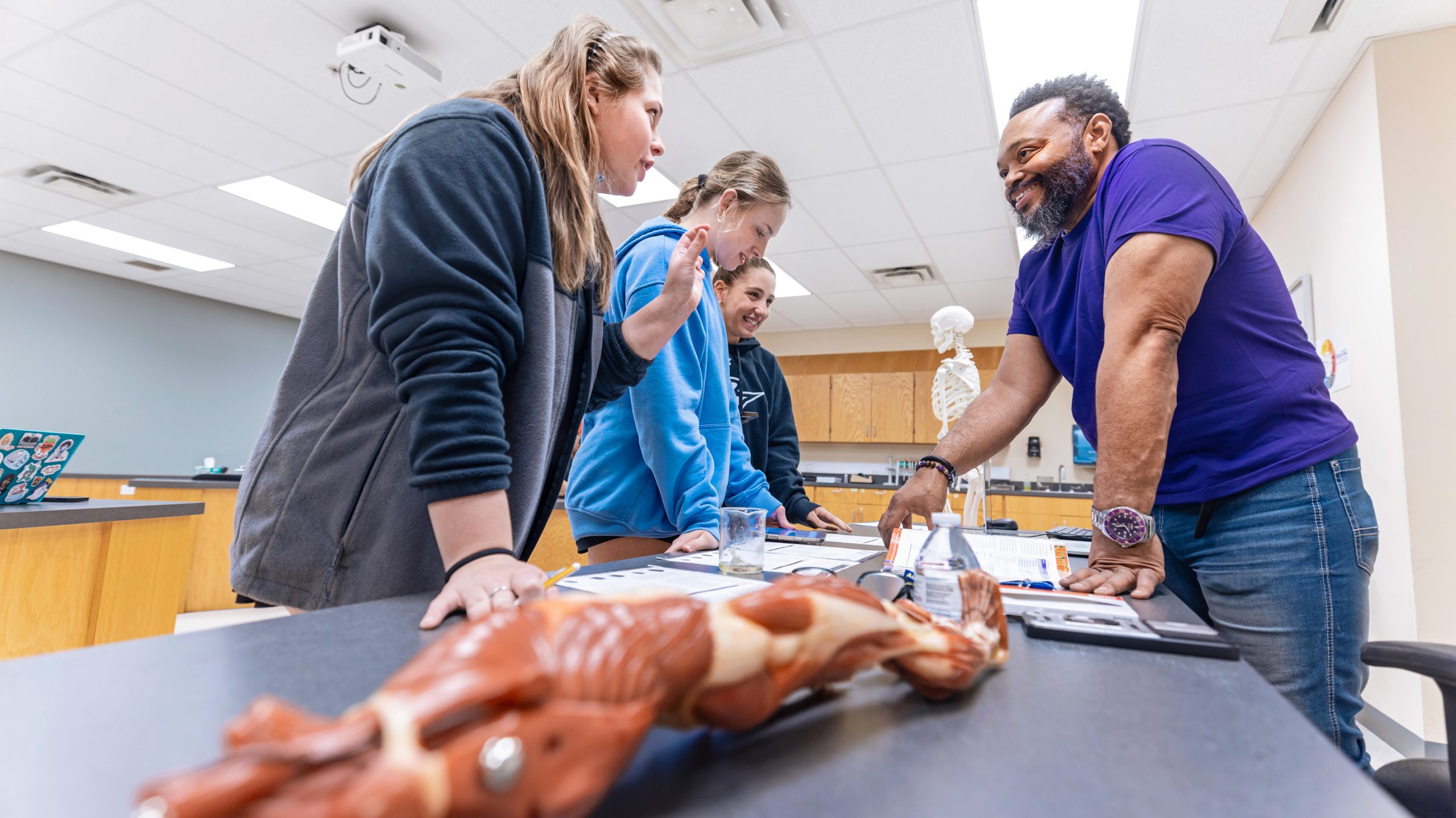
Master of Science in Health Science
MSHS Program Overview
Millions of patients are looking for healthcare providers who prioritize comprehensive wellbeing and integrative approaches. The Master of Science in Health Science prepares professionals who nurture the mind, body, and spirit of each individual through both traditional and complementary therapies. This program equips students to promote overall wellness and lasting health in individuals, families, and communities.
- 100% online
- Full-time and part-time program options available
- 33 credit hours
- Capstone project in integrative health
- Optional practicum in health and wellness coaching
Courses
Spalding’s 33-credit Master of Science in Health Science can be completed as a part-time or full-time degree program. Coursework prepares students for a fulfilling career at the forefront of healthcare practices that value holistic well-being. Courses include Mind-Body Health and Wellness, Health Innovation Fundamentals, and Integrative Approaches to Chronic Illness. Each student also completes a capstone project in integrative health.
Rehabilitation Science Specialization
To prepare students for study in a Doctor of Physical Therapy program, our Master of Science in Health Science – Rehabilitation Science Specialization provides basic science education and skills applicable to the clinic. Graduates who successfully complete all program requirements will be offered automatic admission into the second year of Spalding’s DPT program.
Tuition
Could a Master of Science in Health Science be your next step toward wellness? Learn about tuition and fees for our program, as well as your financial aid options.
Early Admission
Undergraduate students currently working on the degree requirements for the Bachelor of Science in Health Science, or a related undergraduate degree, are eligible to apply for early admission to the Master of Science in Health Science program.
- 75 hours must be completed at the undergraduate level before applying
- The student must have an undergraduate GPA of 3.0 or higher after completing 75 hours
- Before enrolling, the student must meet all current admission requirements and be accepted into the graduate program
- Nine (9) credit hours (3 graduate courses) in the program can satisfy 9 credit hours in the undergraduate program
Opportunities in Health Science
The rising global wellness industry, projected to reach $4.9 trillion by 2025 (Global Wellness Institute), indicates a shifting focus toward preventive and holistic approaches to healthcare.
The projected 17% growth in healthcare occupations (U.S. Bureau of Labor Statistics) includes a demand for integrative health practitioners.
The demand for wellness coaches is expected to grow by 35% (National Board for Health and Wellness Coaching).
Occupations that focus on supporting wellness are projected to have strong growth and many openings from 2021 to 2031—with most having wages that were higher than the median for all workers in 2021 (U.S. Bureau of Labor Statistic).
Admission Requirements
Ready to meet the needs of the times through holistic healthcare? Discover how Spalding’s MSHS can accelerate your career on your terms.
Accreditation
Spalding University is accredited by the Southern Association of Colleges and Schools Commission on Colleges (SACSCOC) to award associate, baccalaureate, masters, and doctorate degrees.
Find Possibility in the Heart of the City
DISCOVER YOUR GROWTH POTENTIAL
Find your fit in a booming industry — the Bureau of Labor Statistics projects that healthcare and social assistance will have the largest job growth and be the fastest growing industry sector between 2024 and 2034.
High-Impact Career Preparation
Meet the needs of the times by contributing to positive health outcomes. Health science professionals excel in a range of roles, including:
- Consultant
- Health and wellness coach
- Healthcare administrator
- Lifestyle consultant
- Medical assistant
quote needed
xx
Spalding’s Master of Science in Health Science program is led by the Kosair College of Health and Natural Sciences faculty.

Program Outcomes
- Demonstrate an in-depth understanding of integrative health concepts, theories and practices
- Apply evidence-based strategies to assess and address individual, community and population health needs
- Develop and implement integrative health programs, interventions and policies
- Utilize advanced communication and interprofessional collaboration skills in healthcare and wellness contexts
- Evaluate the complex network that constitutes “mind-body” and construct an integrative mind-body plan for a wide range of clients
- Utilize a range of Integrative Health Education knowledge, skills and processes, especially when encountering challenging education situations
- Develop integrative treatment plan metrics for outcomes across illness and wellness populations
- Conduct research and contribute to the evolving field of integrative health
- Promote ethical and culturally sensitive integrative health practices